Project

Invasive Alien Species Management Project in Malawi
The Enhancing Sustainability of Protected Area systems in Malawi, and Stabilising Agro-production in Adjoining Areas through an Improved IAS management Project in short known as the Invasive Alien Species (IAS) Management Project aims to enhance the capacity of Malawi to manage Invasive Alien Species, especially in protected areas and surrounding agro-ecosystems by strengthening existing national and protected area specific frameworks for the prevention and management of IAS.
Environmental Affairs Department (EAD) is the Executing Agency in Malawi while UNEP is its implementing agency. Other support executing agencies are Centre for Agriculture and Biosciences International (CABI) which provides technical support, the Department of National Parks and Wildlife, the Department of Forestry, the Department of Museums and Monuments, National Herbarium and Botanical Gardens, Forest Research Institute, the Department of Agriculture Research Services, Peace Parks Foundation and Mulanje Mountain Conservation Trust, Lilongwe Wildlife Trust, Total Land Care and Wildlife Environment Society of Malawi among others who are providing technical and co-financing support. The project started in 2019 and will run through to 2025.
The objective of this project is to prevent new invasions and reduce the current impacts of IAS in protected areas and adjoining agro-ecosystems in Malawi. The project seeks to:
- Establish a national framework and capacity to enhance IAS management in protected areas and associated agro-ecosystems
- Strengthen on-the-ground IAS management in existing protected areas through invasive species control and habitat restoration, as well as in adjoining agro-ecosystems through sustainable farming for improved welfare, and to
- Improve knowledge management and broader adoption of developed strategies in Malawi-protected areas.
National IAS management has received an additional boost through the adoption of the National Invasive Species Strategy and Action Plan (NISSAP) as well as the Communication Strategy.
The Malawi Environment Protection Authority (MEPA) has included the management of Invasive Alien Species as one of its priorities areas in its 5-year draft strategic plan. To ascertain its commitment to the fight against IAS, MEPA has funded activities in the NISSAP.
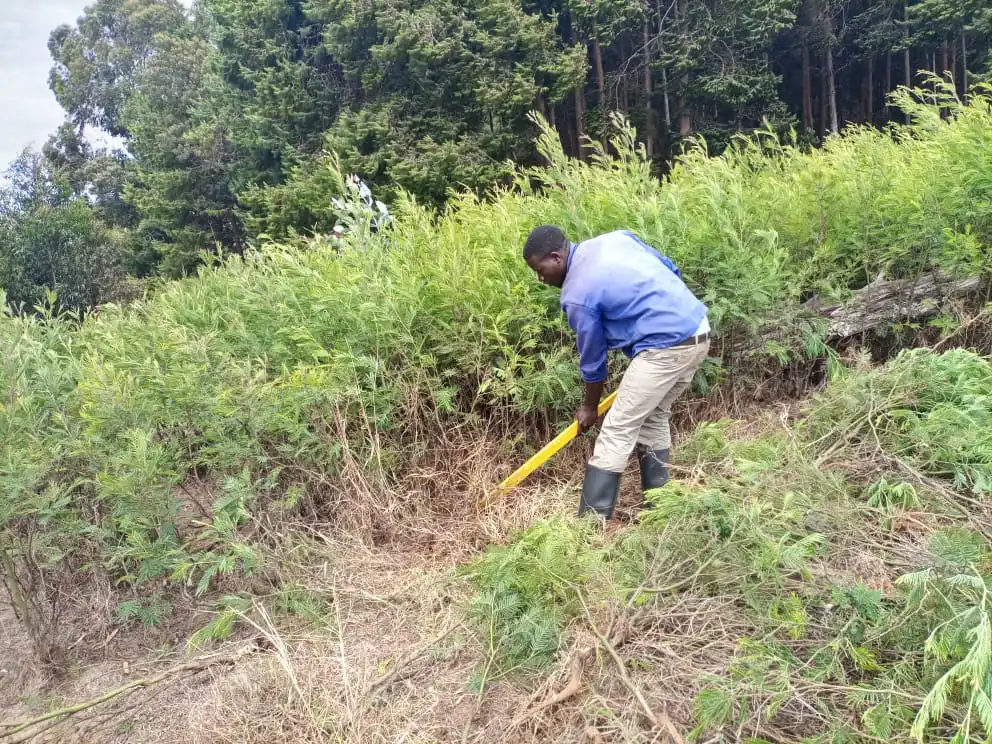
The project has already significantly strengthened the integration of IAS aspects in the management operations of Malawi's protected areas (e.g., clearing of Pine and other IAS).
The Project has contributed to capacity building of protected areas' staff. Staff from forest reserves, wildlife reserves and national parks were trained at the Malawi College of Forestry and Wildlife (MACOFOW), the college that is mandated to train protected area staff. The course on IAS Management has been include in its curriculum.
The project support has led to a significant increase in management effectiveness as measured by the METT scorecard. As one of the few GEF project countries, the project has succeeded in obtaining government permission and passing the various safety measures to import bio-control agents to control the spread of several IAS.
Work has started on management of IAS in agro-ecosystems adjoining the two protected areas, which is being led by Local Coordination Units at District Council level, comprising local government departments, non-governmental organisations, community leaders and other local experts who work hand in hand with protected areas' authorities on shared IAS concerns.
Awareness programmes are underway on radio, TV and newspapers including through extension officers and NGOs to enhance knowledge and action on IAS at national, subnational and community levels.
Since the adoption of the NISSAP, several projects and institutions have taken up some activities of the NISSAP for implementation. Phase 2 of the Shire Valley Transformation Project, the GEF-funded Forest Landscape Restoration Project, the Malawi University of Science and Technology research project and Lilongwe University of Science and Technology among others, have taken up some activities on IAS from the NISSAP.